
Lot Traceability: What It Is, How It Works, and Where It Stops

What is lot traceability?
Lot traceability is the ability to follow a group of products made together, called a lot or batch, backward to the materials and production run that created it and forward to every customer who received it. Manufacturers use it to investigate defects, limit the size of a recall and prove chain of custody to regulators.
- A lot is a group, not a unit. Every item made in the same run, from the same materials, shares one lot number.
- It works in two directions. Trace back to suppliers and the production run; trace forward to every shipment and customer.
- Lot and batch mean the same thing in practice. A serial number is different: it identifies one single item.
- Regulators set the pace. The FDA Food Traceability Rule requires lot-level records and expects them within 24 hours of a request.
- It has three blind spots. It cannot narrow a recall below the lot, it usually ends at your warehouse door, and a printed lot number does not prove a product is genuine.
- Unit-level serialization closes those gaps. Smart Epsilon gives each unit its own verified identity and ties it to its batch, line and shift.
“A defect just surfaced in one batch. How much of your inventory do you have to recall?”
If your team can answer that question in minutes, with a list of exactly which shipments went where, you have working lot traceability. If the honest answer is “give us a few days”, you have lot numbers printed on a label and not much more. This guide explains what lot traceability is, how it works, what regulators expect, and the point where tracking by lot stops being enough.
What is a lot, and what is a lot number?
A lot is a quantity of product made under the same conditions: the same production run, the same line, the same raw materials, usually the same day or shift. Because everything in the lot shares those conditions, a problem found in one item is assumed to affect all of them.
A lot number (also called a lot code) is the identifier assigned to that group. It is printed on the unit, the case, or both, and recorded against every transaction the lot passes through. On packaging it usually sits near the expiry or manufacturing date, marked “LOT”, “L” or “Batch”. In a GS1 barcode it is carried under application identifier (10), “batch or lot number”.
Lot number vs batch number vs serial number
These three terms get mixed up constantly, and the difference decides how precise your traceability can be.
| Lot number | Batch number | Serial number | |
|---|---|---|---|
| Identifies | A group of units made together | A group of units made together | One single unit |
| How many items share it | Hundreds to millions | Hundreds to millions | Exactly one |
| Typical use | Recalls, quality holds, expiry control | Same as lot; common in process industries | Warranty, authentication, unit-level tracking |
| GS1 application identifier | (10) | (10) | (21) |
| Smallest thing you can recall | The whole lot | The whole batch | A single unit |
In everyday use, lot and batch are interchangeable: GS1 treats them as one data element. Some industries prefer “batch” for products made by mixing or formulating, such as chemicals and pharmaceuticals, and “lot” for discrete goods, but the tracing logic is identical. A serial number is the one that behaves differently, and that difference matters later in this guide.
How does lot traceability work?
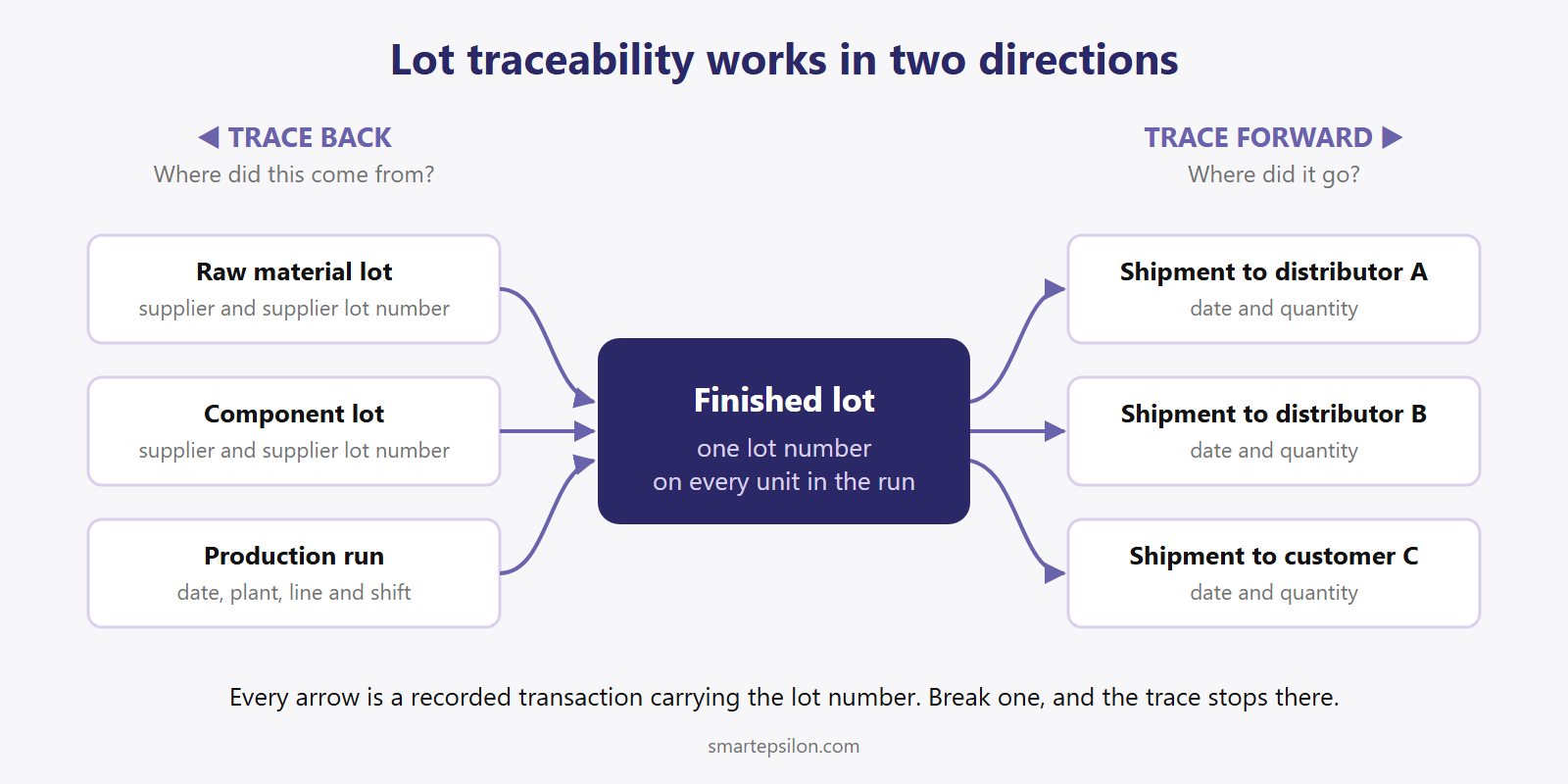
Lot traceability is a chain of records. Each time a lot is created, moved, transformed or shipped, the lot number is written into that transaction. Follow the chain in either direction and you can answer two different questions.
Backward tracing: where did this come from?
Starting from a finished lot, you trace back to the production order, the line and shift, the operators, and the lot numbers of every raw material or component consumed. This is how a quality team finds the root cause: one supplier lot of resin, one faulty batch of an active ingredient, one shift on one line.
Forward tracing: where did it go?
Starting from a raw-material lot or a finished lot, you trace forward to every other lot it went into and every customer shipment that carried it. This is how you scope a recall: not “everything we made in March”, but these 14 shipments to these 9 customers.
A system that can do both is often described as having bi-directional traceability or lot genealogy: a family tree for a product.
What should a lot record contain?
The lot number on its own is only a label. Traceability comes from the data attached to it:
- What it is: product or SKU, quantity produced, unit of measure.
- When and where it was made: date, plant, line and shift.
- What went into it: supplier and lot number of each input material.
- What was checked: quality results, holds and releases.
- Where it went: each movement, dispatch and receipt, with customer and date.
- When it expires: expiry or best-before date, where it applies.
If any of these lives in a separate spreadsheet, a paper batch record or someone’s memory, that is the step where a trace will stall.
Who requires lot traceability?
Most manufacturers keep lot records because their customers and auditors expect it. In some industries it is the law. Two US examples show how far the requirement can go.
Food: the FDA Food Traceability Rule (FSMA 204)
The FDA’s Food Traceability Final Rule applies to businesses that manufacture, process, pack or hold foods on the agency’s Food Traceability List. In the FDA’s words, they must “maintain records containing Key Data Elements (KDEs) associated with specific Critical Tracking Events (CTEs)” and provide that information to the FDA “within 24 hours or within some reasonable time to which the FDA has agreed.” The rule is built around a traceability lot code that travels with the food.
The original compliance date was January 20, 2026. The FDA proposed extending it by 30 months, to July 20, 2028, and Congress has since directed the agency not to enforce the rule before that date.
Prescription drugs: the Drug Supply Chain Security Act (DSCSA)
Pharmaceuticals go a step further than the lot. The FDA describes the DSCSA as setting out steps to “identify and trace certain prescription drugs at the package level as they move through the supply chain.” Package level means each saleable pack is identified individually, not just the lot it belongs to.
Regulatory details are as of October 2026 and come from the FDA pages linked above. Dates and enforcement policies change. This is a summary, not legal advice: confirm your obligations against the current rule text.
Where does lot traceability stop?
Lot traceability is necessary. It is rarely sufficient. Three limits show up again and again.
1. A lot is the smallest thing you can recall
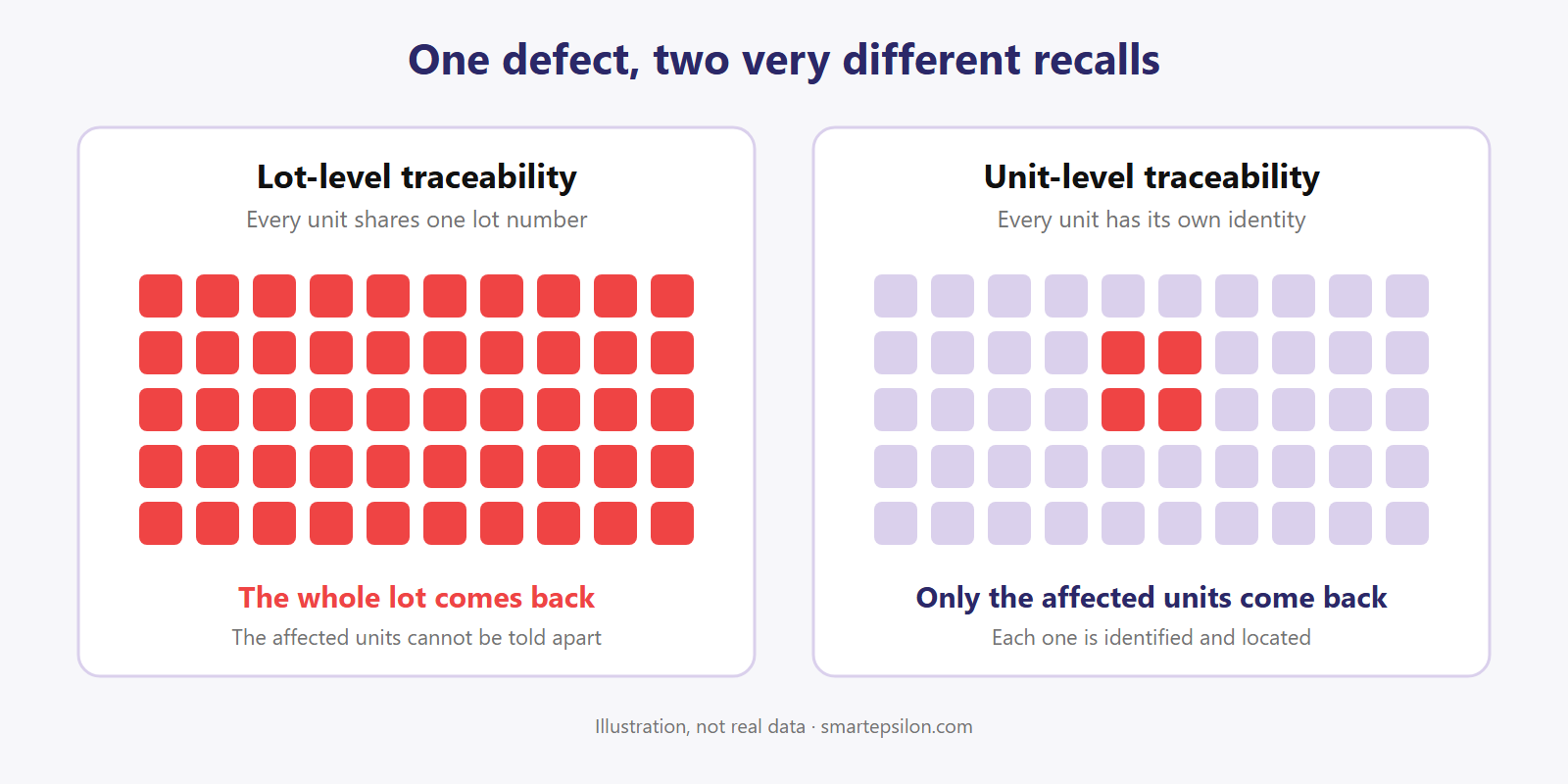
If one lot holds 200,000 units and the defect affects 3,000 of them, lot-level records cannot tell those 3,000 apart from the rest. The whole lot comes back. The bigger your lots, the bigger your minimum recall.
2. Visibility usually ends at your warehouse door
An ERP records that a lot was shipped to a distributor. It rarely records that the distributor received it, where it went next, or whether it has been sold. “Shipped” and “received” are assumed to match. When a recall or a dispute arrives, that assumption is what gets tested.
3. A lot number proves nothing about authenticity
A lot number is printed text. Anyone can read it off a genuine pack and print it on a copy. Thousands of real units legitimately share the same code, so one more does not stand out. Lot traceability tells you where your product went. It does not tell you whether the product in someone’s hand is yours.
Lot-level vs unit-level traceability
Unit-level traceability, also called serialization, gives every single item its own identity and links that identity to its lot. You keep everything lot traceability gives you and remove the three limits above.
| Question | Lot-level traceability | Unit-level traceability |
|---|---|---|
| How small can a recall be? | One lot | The exact affected units |
| Can you confirm a distributor received it? | Usually assumed from paperwork | Confirmed by a scan at each handoff |
| Can you see what actually sold? | No, only what shipped | Yes, from scan-confirmed sell-through |
| Can a customer check it is genuine? | No | Yes, each unit can be verified |
| Can you spot a diverted or cloned product? | No | Yes, when a code appears where it should not |
| What it needs | Lot numbers and disciplined record-keeping | A unique code on every unit and scans along the route |
Not every product needs unit-level tracking. For low-value, low-risk goods, well-run lot traceability is the right answer. The case for going further is strongest where a recall is expensive, where product moves through independent distributors and dealers, or where counterfeits and diversion are a real risk.
How to tighten the lot traceability you already have
- Run a mock recall. Pick a finished lot at random and time how long it takes to list every input lot and every customer shipment. The number of hours is your real traceability score.
- Make lots smaller where risk is higher. A lot per shift instead of per day cuts the size of your worst-case recall.
- Capture lot numbers by scan, not by typing. Most broken traces start with a mistyped code.
- Record input lots at the point of use. Link supplier lots to the production order as material is consumed, not afterwards from memory.
- Confirm receipt, not just dispatch. Ask the next party in the chain to scan what arrives.
- Keep it in one system. A trace that crosses five tools is five places for the chain to break.
How Smart Epsilon extends lot traceability to the unit
Smart Epsilon’s Track & Trace gives every unit a verified identity at the point of manufacture, with its batch, line and shift tied to it permanently, and follows that unit through warehouse, distributor and retailer to the consumer’s scan.
| Feature | The problem it solves | The impact |
|---|---|---|
| Unit-level serialization at source | No way to trace a specific unit back to its exact production batch, line or shift | Recalls narrow to the exact affected batch |
| Dispatch and receipt confirmation at every stage | “Shipped” and “received” are assumed to match, and rarely proven to | Custody is proven, not assumed |
| GS1 EPCIS 2.0 native data model | Data trapped in a proprietary format that partners and regulators cannot use | Standards-based data exchange on demand |
| Automated chain-of-custody trail | Rebuilding a shipment’s history for a legal or regulatory request takes weeks | Full history available in minutes |
It works with SAP, Oracle or any ERP: your ERP keeps tracking inventory counts, and Smart Epsilon adds the identity of each physical unit. The same identity is what the Anti-Counterfeiting Solution verifies, which is how a lot record becomes proof that a product is genuine.
To date, Smart Epsilon has serialized 320M+ units, with 95% scan compliance across the network and a 20–25% reduction in stockouts.* One deployment for an agrochemical manufacturer covers 10+ countries, 15+ manufacturing plants and 100,000+ retailers: read the case study.
* Aggregated client data, 2023–2026. Full methodology available on request.
See what lot and unit-level traceability looks like on your actual SKUs. Schedule a Demo
Frequently asked questions
What does lot tracking mean?
Lot tracking means recording a lot number against every step a group of products passes through, from the materials used to make it to the customers who receive it. It lets a manufacturer answer two questions quickly: what went into this lot, and where did this lot go. The terms lot tracking and lot traceability are used interchangeably.
What is a lot number?
A lot number is a code that identifies a group of products made together in the same production run. Every unit in that group carries the same number. It is used to trace quality problems, manage expiry dates and decide which products to pull in a recall.
How do you identify a lot code on a product?
Look near the expiry or manufacturing date, where the lot code is usually printed or embossed and labeled “LOT”, “L”, “Batch” or “B/N”. On products with a GS1 barcode, the lot number follows the application identifier (10). If you cannot find it, the manufacturer’s customer service can tell you where it appears on that product.
Is a lot number the same as a batch number?
In practice, yes. Both identify a group of products made together, and the GS1 standard treats them as a single data element, “batch or lot number”. Some industries prefer one word over the other, with “batch” more common for formulated products such as chemicals and medicines, but they are traced the same way.
What is the difference between a lot number and a serial number?
A lot number is shared by every unit made in the same run, while a serial number belongs to one unit only. A lot number lets you recall a group; a serial number lets you identify, verify or recall a single item. Many products carry both: the serial number identifies the unit and the lot number shows which production run it came from.
What does traceability refer to?
Traceability is the ability to follow a product’s history, location and use through recorded identification. In manufacturing it means being able to show what a product is made of, how and when it was made, and where it went afterwards. Lot traceability does this for groups of products; unit-level traceability does it for each individual item.
What is track and trace in pharma?
In pharmaceuticals, track and trace means identifying and following prescription drugs through the supply chain. In the United States, the Drug Supply Chain Security Act sets out steps to identify and trace certain prescription drugs at the package level, so that each saleable pack is identified individually and not only by its lot. The aim is to keep harmful or illegitimate drugs out of the supply chain and remove them quickly if they get in.
Is lot traceability required by law?
It depends on the product and the country. In the United States, the FDA Food Traceability Rule requires lot-level records for foods on the Food Traceability List, and prescription drugs must be traceable at the package level under the DSCSA. Many other manufacturers keep lot records because customers, certifications and insurers expect them, even where no specific law does.