
Anti-Counterfeit Labels: Types, How They Work, and What They Can’t Stop

What is an anti-counterfeit label?
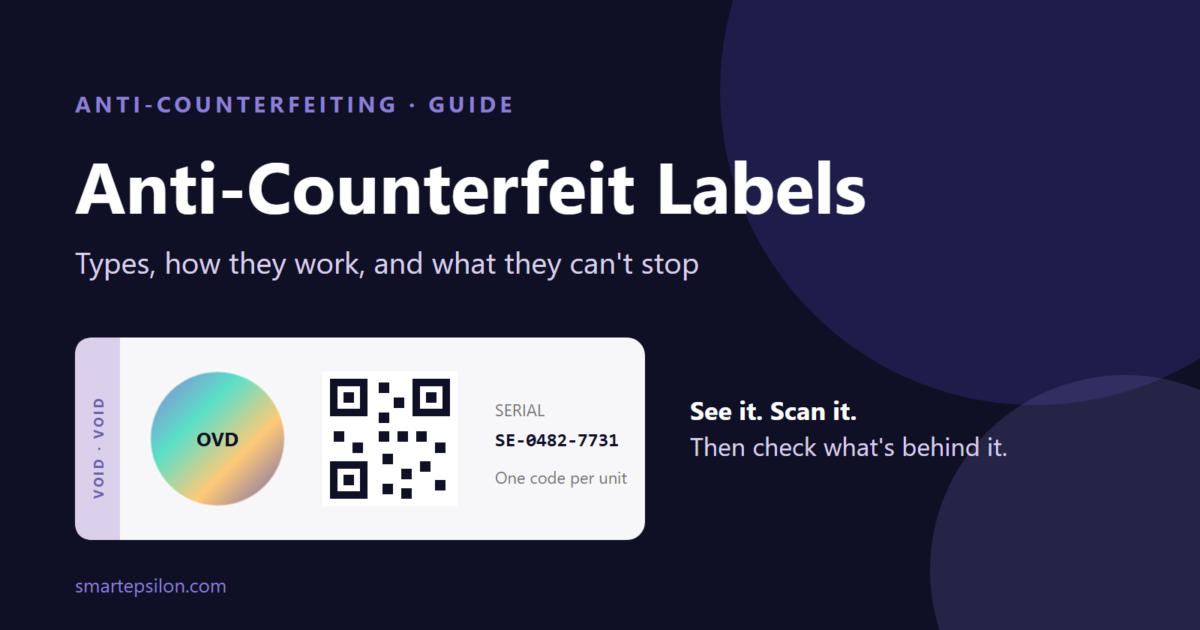
An anti-counterfeit label is a label built to be hard to copy and easy to check, so a buyer, inspector or distributor can tell a genuine product from a fake. It combines visible features such as holograms or tamper-evident film with hidden marks or a unique scannable code that is checked against the brand’s own records.
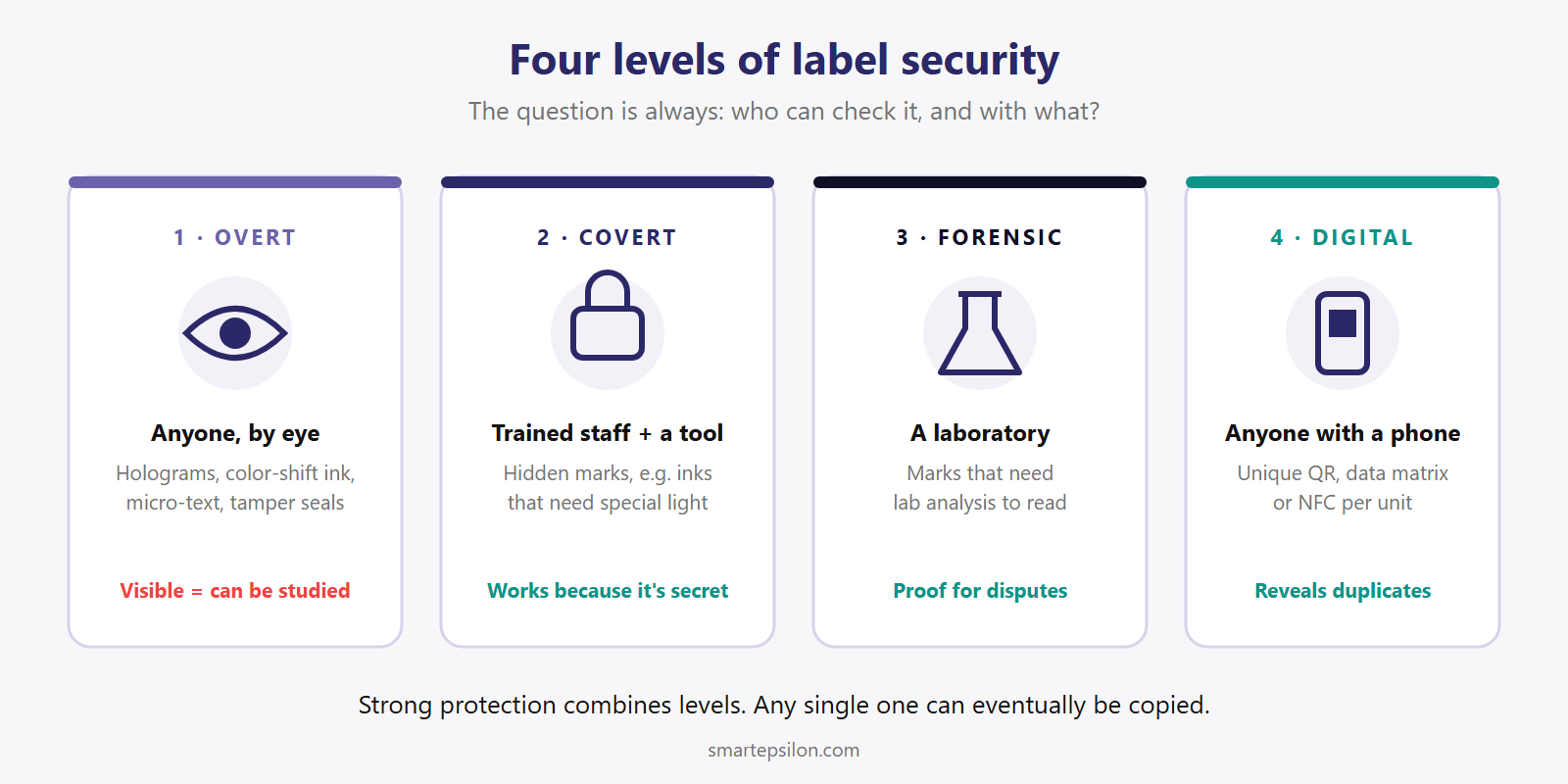
- There are four kinds of feature. Overt (anyone can see it), covert (needs a tool), forensic (needs a lab) and digital (a unique code checked online).
- Every visible feature can be imitated. A look-alike hologram fools most people; that is why serious protection never relies on one method.
- Tamper-evident is not the same as authentic. A VOID or destructible label shows that a pack was opened. It does not prove the product inside is yours.
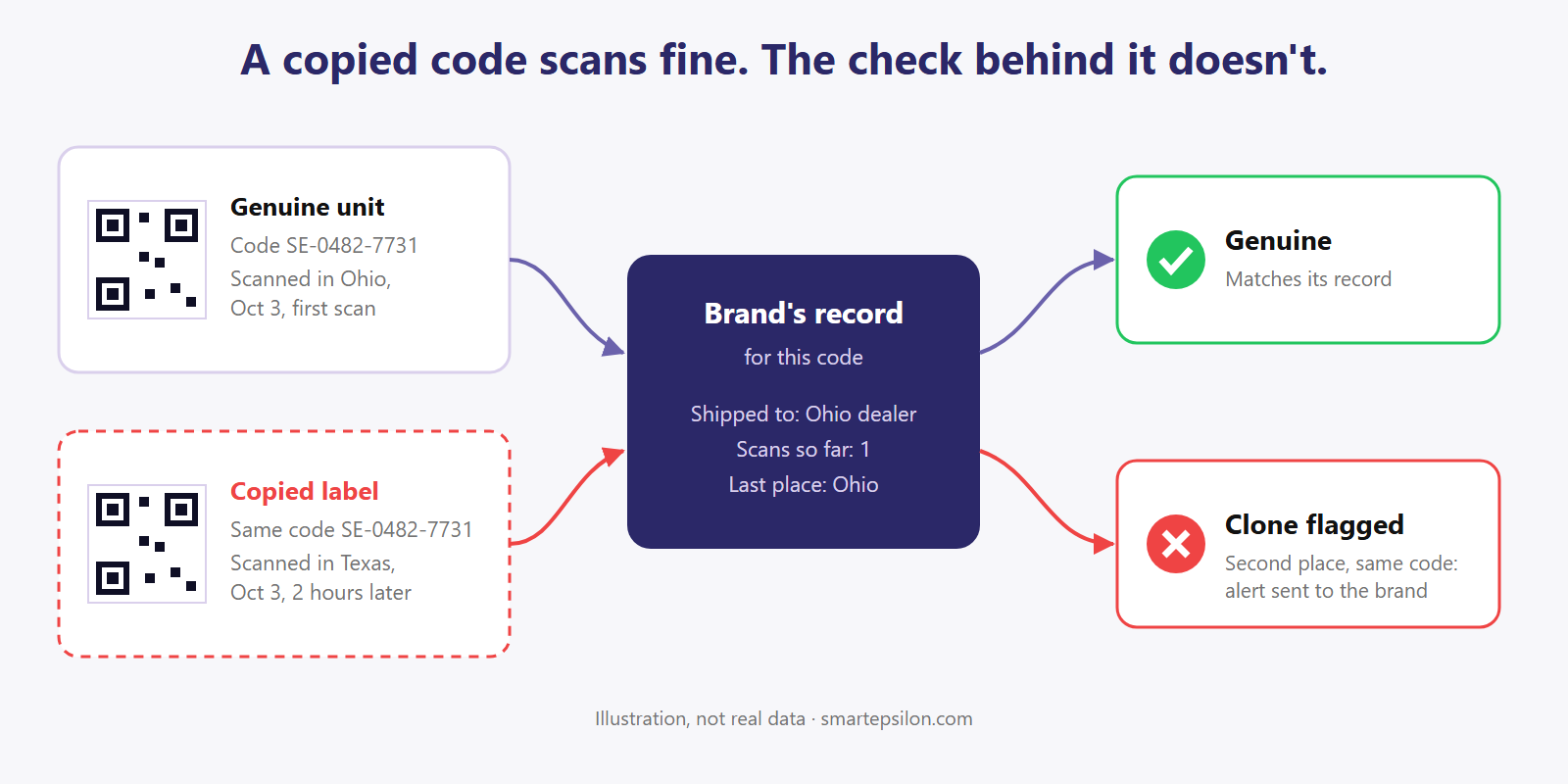
- A QR code can be copied in seconds. What protects you is what happens after the scan: one code per unit, and an alert when the same code appears twice.
- Choose by risk, not by price per label. Who checks the product, where fakes enter, and whether packs get refilled decide the right mix.
- Smart Epsilon uses three independent layers. A tamper-evident holographic label anyone can check, plus two undisclosed layers behind it.
“A customer holds your product in their hands and still isn’t sure it’s real.”
That moment turns into a support call, a return or a public post questioning your brand. The label on the pack is usually the first, and often the only, thing that person can check. This guide explains the main types of anti-counterfeit label, what each one actually proves, what a counterfeiter can copy, and how to choose the right combination for your product.
The problem is not small. The OECD estimates that counterfeit and pirated goods accounted for up to 2.3% of global trade in 2021, the latest year of customs data in its 2025 report.
What makes a label “anti-counterfeit”?
Any label can carry a logo. An anti-counterfeit label is designed around two questions instead: how hard is it to copy, and how easy is it for the right person to check? Security features are usually grouped by who can verify them:
| Level | Who can check it | Typical features | What it is good for |
|---|---|---|---|
| Overt | Anyone, by eye, no device | Holograms, color-shifting inks, micro-text, tamper-evident seals, visible serial numbers | A quick first check by consumers, retailers and field teams |
| Covert | Trained staff with a simple tool | Hidden marks such as inks that only show under a special light | Inspections and disputes, without telling counterfeiters what to copy |
| Forensic | A laboratory | Marks that need lab analysis to read | Proof that holds up in an investigation or in court |
| Digital | Anyone with a smartphone | A unique QR code, data matrix or NFC tag per unit, checked against an online record | Instant verification, plus data on where and when products are scanned |
The ISO 22383:2020 guideline on choosing authentication solutions uses the same idea: a solution is judged by how well it lets a defined person establish that a product is genuine, across the product’s whole life cycle, not by how impressive the label looks.
The main types of anti-counterfeit label
Holographic labels
A hologram, or more broadly an optically variable device (OVD), changes as you tilt it: colors shift, images move or switch. It is the classic overt feature because anyone can check it in a second, with no device. Its weakness is the same: because everyone can see it, counterfeiters can study it, and a cheap look-alike foil is often enough to fool someone who has never seen the real one. A hologram raises the cost of faking; on its own it does not stop a determined counterfeiter.
Tamper-evident labels and seals
Tamper-evident labels show that a pack has been opened. Common versions leave a “VOID” pattern on the surface when peeled, or are made of destructible film that breaks into pieces so it cannot be lifted off in one piece and reused. They are the right answer to one specific question: has this been opened since it left the factory? They do not answer a different one: is the product inside genuine? A counterfeiter who prints their own tamper-evident labels can seal a fake perfectly.
QR code holograms
A QR code hologram puts a scannable code on, or next to, a holographic label, so one label gives both an eye check and a phone check. It is one of the most searched label types in this space. The value is not in the hologram or the code alone, but in what the code connects to, which the next section covers.
Serialized QR codes and data matrix codes
A serialized code gives every single unit its own identity, the same idea as serial numbers in lot and batch traceability, taken down to each item. When someone scans it, the code is looked up in the brand’s records: is it real, which product and batch does it belong to, and has it been scanned before, and where?
NFC and RFID tags
Near-field communication (NFC) and RFID tags store an identity on a small chip that a phone or reader can read without line of sight. Cryptographic chips are much harder to clone than a printed code. They cost more per unit and need to be built into the label or pack, so they are most common on high-value items.
Covert and forensic marks
Covert marks are deliberately invisible or meaningless to the untrained eye, and forensic marks can only be read in a lab. Their strength depends on secrecy. That is why credible vendors do not publish how theirs work, and why you should be wary of anyone who explains their “hidden” feature in a sales brochure.
Can a QR code be counterfeited?
Yes, and easily. A printed QR code is just a pattern; anyone with a phone and a printer can copy it in seconds. A copied code scans exactly like the original. So the protection is never the printed code itself. It is what happens on the other side of the scan:
- One code per unit, not per product line. If every bottle in a range carries the same code, a counterfeiter only needs to copy it once.
- A scan history for each code. A genuine unit is normally scanned once by its buyer. The same code scanned hundreds of times, or in two cities on the same day, is a copy.
- Alerts, not just a green tick. A duplicate scan should raise an alert to your team, not quietly tell the second scanner the product is fine.
- A code that can only be scanned after opening. Printing the code under the cap or seal stops it being read on the shelf, copied in bulk, or reused on a refilled pack.
What anti-counterfeit labels can’t stop
Labels are necessary. On their own, they leave four gaps:
- Look-alikes of the overt feature. Most people have never seen your real hologram up close, so a convincing imitation passes a casual check.
- Genuine packaging, fake contents. Empty genuine containers can be collected, refilled and resealed, which is why tamper evidence and where the code sits matter so much.
- Diversion. A genuine product sold in a market or channel it was never meant for has a genuine label. Only scan data, matched against where each unit was shipped, shows that it has moved.
- The same leak, again. Stopping one fake batch does not close the gap it came through. Without tracing a counterfeit back to where it entered the supply chain, the same source keeps producing the same problem.
How to choose anti-counterfeit labels for your product
Start from your risk, not from a label catalog. Five questions settle most decisions:
| Question | If the answer is yes… | …consider |
|---|---|---|
| Do end customers need to check the product themselves? | They have no tools and a few seconds | An overt feature plus a phone-scannable code; no app required |
| Are genuine containers refilled or resealed? | Empty packs have resale value | Tamper-evident film and a code that is only readable once the pack is opened |
| Does product leak into the wrong markets or dealers? | Diversion is as costly as fakes | Serialized codes linked to where each unit was shipped |
| Do disputes end up with regulators, insurers or courts? | You need proof, not opinion | A covert or forensic layer in addition to the overt one |
| Is the line already running at full speed? | New hardware is hard to justify | Features that fit your existing packaging and printing workflow |
Then test the choice the way a counterfeiter would: which part could someone copy from a photo? If the honest answer is “all of it”, add a layer they cannot see.
Labels by industry
Agrochemicals
Look-alike crop protection products are often sold below list price by unregistered formulators and repackagers. Farmers and retailers need a check that works before purchase, in the field, with no device; brand teams need to know when a cloned code appears anywhere in the channel. See anti-counterfeiting for agrochemicals.
Lubricants and oil & gas
Refill fraud is the specific risk: a genuine container, emptied and refilled. Placing the verification code under the cap or seal means the container must be opened before it can be scanned, which closes off pre-scanning, code reuse and refills. See how this works for fuel and lubricant marketers.
Electrical appliances and parts
Here the fake is often the mark, not the product: a printed UL or ETL logo on goods that were never certified, or a counterfeit component that is installed and never seen again. Verification has to cover the product and its certification mark together. See electrical appliances and parts.
How Smart Epsilon approaches anti-counterfeit labels
Smart Epsilon’s Anti-Counterfeiting Solution is built on the gaps above: a single method is exactly what a counterfeiter learns to copy, so it uses three independent layers at once.
| Feature | The problem it solves | The impact |
|---|---|---|
| Tamper-evident, nano-OVD holographic security label | Consumers and retailers have no way to check authenticity before scanning anything | A visible check before a single scan happens |
| Consumer-facing QR verification | Verifying authenticity feels technical or needs a special app | Any smartphone camera, no app required, result in seconds |
| Two undisclosed layers behind the label | Once a single method is public, it is only a matter of time before it is copied | A counterfeiter has to beat three independent layers, and can only see one |
| Root-cause investigation on every confirmed counterfeit | Stopping one fake batch doesn’t close the leak it came from | The point where the counterfeit entered the supply chain is found and closed |
The two hidden layers are, deliberately, not described here or anywhere else: publishing how they work would hand a counterfeiter the one thing they need. All three layers fit into an existing packaging workflow, with no new packaging or printing hardware. The same unit identity also powers Track & Trace, so a scan can show not just whether a product is genuine but where it should have been.
Smart Epsilon reports 320M+ units serialized and 99.2% verified authentic. In one deployment, the head of brand protection at an agrochemicals major put it this way: “Within two quarters, Smart Epsilon’s anti-counterfeiting solution significantly reduced counterfeit-related complaints. Our field team can now identify cloned products before they reach customers.” Read the agrochemicals case study.
See how three layers catch what one label can’t. Schedule a Demo
Frequently asked questions
What is a tamper-evident label?
A tamper-evident label is a label that shows visible, permanent damage if someone tries to remove it, so you can tell a pack has been opened. Common types leave a “VOID” pattern behind when peeled, or break into small pieces so they cannot be lifted off and reused. Tamper evidence shows that a pack was opened; it does not prove that the product inside is genuine.
What is tamper-evident packaging?
Tamper-evident packaging is packaging designed so that opening it leaves a clear sign, such as a broken seal, a snapped cap ring or a torn label. Familiar examples are the foil seal under a jar lid and the breakable ring on a bottle cap. It protects buyers from products that were opened, refilled or interfered with after leaving the factory.
Can a QR code be counterfeited?
Yes. A printed QR code can be copied with a phone and a printer in seconds, and the copy scans like the original. Protection comes from what happens after the scan: a unique code for every unit, a record of where and how often each code is scanned, and an alert when the same code shows up twice.
How is counterfeiting prevented?
Counterfeiting is prevented by making products hard to copy and easy to check, and by acting on what the checks reveal. In practice that means layered security features on the pack, a unique identity for each unit, verification that customers and field teams can do themselves, and investigating confirmed fakes back to where they entered the supply chain.
What is the best anti-counterfeiting solution?
There is no single best feature, because any one method can eventually be copied. The strongest solutions combine several independent layers: an overt feature anyone can check, a hidden layer only the brand can verify, and unique digital codes that reveal duplicates. The right mix depends on who checks your product and how fakes reach your market.
What is a QR code hologram?
A QR code hologram is a security label that combines a holographic element with a scannable QR code, so one label offers both a visual check and a phone check. The hologram makes the label harder to imitate at a glance; the code links each unit to the brand’s records. Its real strength depends on whether every unit has its own code and how scans are checked.
What is the difference between a security label and an anti-counterfeit label?
The terms overlap. “Security label” is the broader name for any label with protective features, including tamper-evident seals used simply to show a box was opened. An anti-counterfeit label is aimed specifically at proving a product is genuine, usually by combining hard-to-copy features with a way to verify them.
Do anti-counterfeit labels need new packaging or printing equipment?
Not necessarily. Many label-based features are applied as part of the existing packaging line, either as a separate label or printed onto the pack. Chip-based tags and some covert features need more change. With Smart Epsilon, all three layers fit into the existing packaging workflow without new packaging or printing hardware.