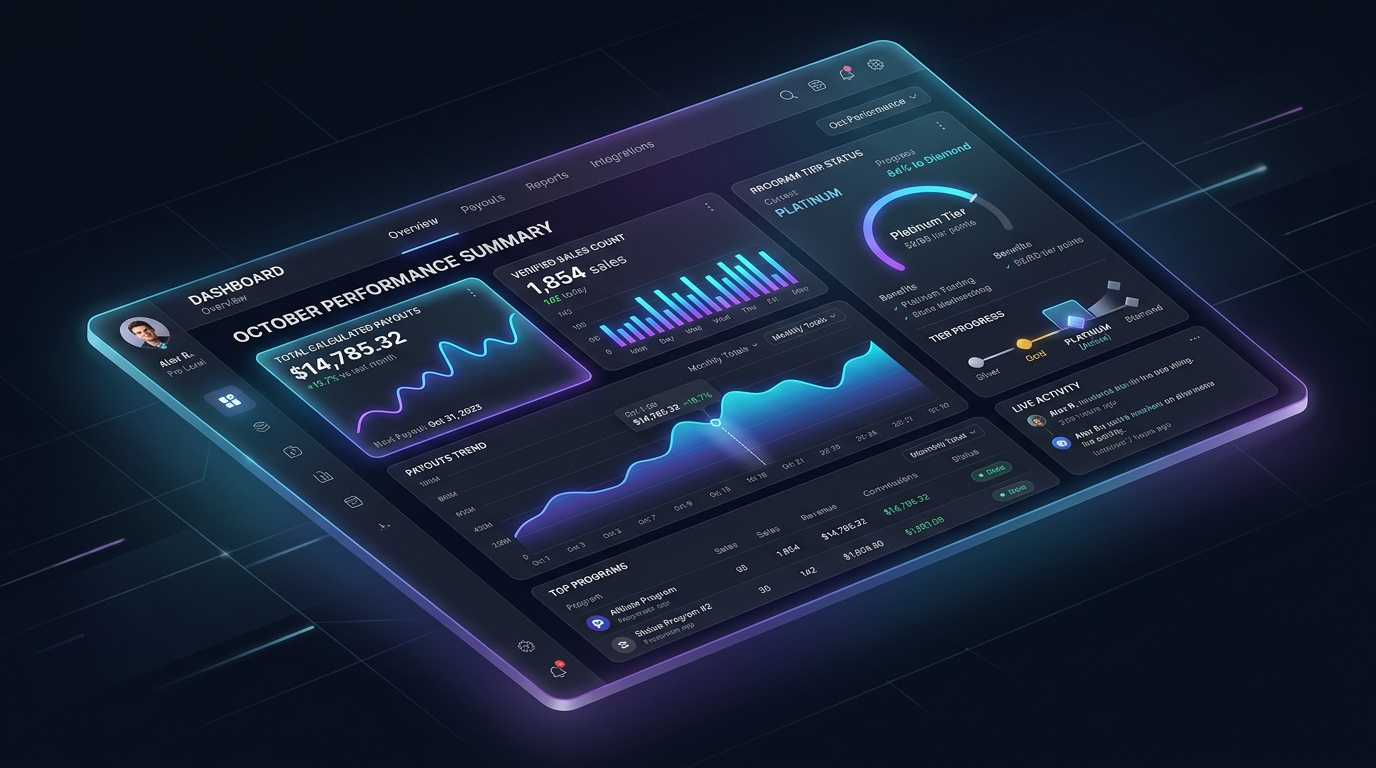

Program Configuration
Build incentive schemes by geography, product line, or customer segment, matching how your business actually structures rebates today.

Payment Linked Incentives
Payment Linked Incentives is Smart Epsilon's distributor incentive management solution. It ties every payout to real invoice clearance and collection — by geography, by product, by customer — so incentive budgets do double duty: rewarding distributors, and directly reducing your Days Sales Outstanding.
Payout Flow
Seven specific capabilities, working together — not a black-box calculation.
Build incentive schemes by geography, product line, or customer segment, matching how your business actually structures rebates today.

Incentive amounts are calculated using verified invoice clearance and collection data, not shipment or order data — so the incentive itself becomes a lever for faster payment, not just a reward for ordering.

Distributors choose which outstanding invoices to clear first to hit incentive thresholds, giving them a direct, self-directed reason to pay down older receivables sooner.

Every incentive budget is tracked against the sales outcome — and the collection outcome — it was approved to drive, so Finance and Sales work from the same verified numbers.

Every invoice, journal voucher (JV), credit note (CN), debit note (DN), and sales return is captured automatically as it happens — no manual reconciliation.

A full or partial sales return is reflected in the next calculation automatically, with no separate manual adjustment step.

Run incentive calculations by customer, by month, or both — matching your actual reporting cadence, not a fixed schedule.
These aren't billing footnotes. They're the moments a broken incentive process costs real cash, real trust, or a real relationship.
NO MATTER WHO'S ASKING
Sales, finance, or ops, whoever's asking sees the same verified numbers.

No. We calculate the verified incentive amount, tied to real invoice and collection data; your existing finance or ERP system disburses it.

Yes. Calculation, approval, collection tracking, and dispute resolution all move off spreadsheets and onto one connected system.

Yes. Every program is tracked against real invoice and collection outcomes, not the projection it started with.

It's automatically reflected in the next PLI run, no manual adjustment, no separate reconciliation process.
Solution
| Feature | The Problem It Solves | The Impact |
|---|---|---|
| Collection-linked incentive calculation | Incentives paid on orders, not on what's actually been collected | Distributor incentive spend directly drives faster collection instead of funding channel stuffing |
| Distributor-defined invoice priority | Distributors have no incentive-driven reason to clear older invoices first | Distributors self-select which invoices to pay down to hit thresholds — improving receivables aging |
| Full JV / CN / DN / sales return tracking | Manual reconciliation of adjustments and returns against already-calculated incentives | Every adjustment automatically reflected in the next PLI run |
| Program-level budget tracking | No way to verify whether a sales team's PLI budget actually delivered the promised sales — or collection — outcome | Finance and Sales see the same real numbers against the original budget ask |
| Customer-wise and month-wise PLI run | Rigid, one-size-fits-all incentive calculation cycles | Run incentives however your business actually operates — by distributor, by month, or both |
| Full audit trail | Disputed claims have no clear record to resolve them | Every calculation traceable, cutting dispute resolution from weeks to minutes |
| Reconciliation with Track & Trace | Incentive data and physical product movement live in disconnected systems | Every incentive can be cross-checked against verified product movement — the same identity, the same record |
One rollout process
One incentive program on one product line moves fast. A multi-tier program across a full distributor network, with region- and product-specific schemes, takes longer. The sequence below is what stays constant either way.
Map your current incentive structure, budget approval process, and where reconciliation — and collection — breaks down today.
Agree the programs, tiers, geographies, and payout rules to configure, and a realistic date, in writing.
Prove the calculation model against one real program before committing further.
Run one full incentive cycle end-to-end with real distributor invoice and collection data.
Get sales, finance, and channel teams confident on the new dashboard and workflow.
Extend across remaining programs, tiers, geographies, and regions at your pace.
Customer voices
See what supply chain and brand protection leaders
experienced after implementing the platform.
Before you ask
Honest answers, no sales preamble.
No — we calculate the verified incentive amount, tied to real invoice and collection data; disbursement happens through your existing finance or ERP system.
The incentive is calculated against collection, not orders — and distributors choose which invoices to clear to hit their thresholds. Both mechanics push real payment behavior, not just better visibility into existing behavior.
Yes — programs are fully configurable by region, product line, and scheme.
Every calculation has a full audit trail back to the invoice, JV, CN, DN, and collection data behind it — cutting dispute resolution from weeks to minutes.
It's automatically reflected in the next PLI run, whether that's monthly, customer-wise, or both.
Yes — incentive data can be reconciled against verified product movement from Track & Trace, so every payout is checked against real, physical sell-through, not just financial records alone.
Book a demo
REQUEST A SESSION


